Giriş
Açıklaması
şöyle. Yani LinkedIn şirketinde yaratılmış. LinkedIn şirketinde ilk olarak
User-facing analytics özelliklerinden olan
‘Who Viewed My Profile?’ ve
‘Talent Search’ gibi işler için
kullanılmışApache Pinot was created, as was Kafka, at LinkedIn to power analytics for business metrics and user facing dashboards. Since then, it has evolved into the most performant and scalable analytics platform for high-throughput event-driven data.
Uber
Apache Pinot'un petabyte büyüklüğünde veriyi rahatlıkla işleyebileceği duyulunca, ilk önce
“Restaurant Manager" paneli için
kullanılmış. Şu anda fiyatlandırma için kullanılıyor. Açıklaması
şöyle
Uber does not run analytics for reporting. It runs analytics to decide how much a ride costs, how quickly a driver gets matched, how incentives shift, and how supply and demand are balanced while the customer is still on the screen.
This is the reason Uber runs around 600 million Apache Pinot queries every day, which works out to roughly 7,000 queries per second on more than 20 petabytes of data. These are not batch jobs or delayed dashboards. These are live, operational queries sitting directly in the critical path of the product.
Apache Pinot Nedir ?
Açıklaması
şöyle. Bir OLAP veri tabanı ancak bir sürü kaynaktan veri çekebiliyor. Yani hem tarihsel hem de gerçek zamanlı kaynaklardan veri çekebiliyor ve bunları SQL ile sorgulayabilmemizi sağlıyor
Apache Pinot is a distributed OLAP store that can
data from various sources such as Kafka, HDFS, S3, GCS, and so on and make it available for querying in real-time. It also features a variety of intelligent indexing techniques and pre-aggregation techniques for low latency.
Cevaplar hızlı ve güncel. Açıklaması
şöyleAnswers contain fresh data — As soon as the data is ingested, Pinot makes them available for querying, typically within seconds. So, you won’t get any stale data in the answers.
Answers will be quick — Pinot makes sure that you will always get an answer within milliseconds of latency, even though it is super busy or having to scan billions of records to find the answer.
Can answer multiple questions concurrently — You may not be the only one querying Pinot. It could be hundreds or even millions of users querying Pinot concurrently. But Pinot makes sure that it scales and be available to accommodate all that questions.
Pinot is the wrong tool when you need :
i. Large multi-table joins Pinot is optimized for fast scans and aggregations on single denormalized tables. It is not a relational engine.
ii. Exploratory data science Ad hoc queries that scan large parts of the dataset, join many tables, and change constantly belong in a warehouse or notebook environment.
iii. Analyst-driven BI workflows If your workload is dominated by a few people running complex SQL with unpredictable shapes, Pinot is not what you want.
iv. Complex SQL pipelines CTEs, window functions, and deep transformations are not what Pinot is built to do.
Lambda Architecture
Pinot follows the lambda architecture. It supports near-real-time data ingestion by consuming online data directly from Kafka and offline data from the Hadoop system. Offline data will serve as a global view, while online data will provide a more real-time view.
In most data stacks, data flows like this:
Events → Kafka → Data lake → Warehouse → BI → Decisions
By the time anyone looks at the data, the moment is already gone. Pinot flips that model. With Pinot, data flows like this:
Events → Kafka → Pinot → APIs → Product, pricing, alerts, ML systems
Pinot Hangi Problemleri Çözer?
1. User-facing analytics
Dashboards ve Personalization için kullanılır
Dashboards — Pinot has been purpose-built to power user-facing applications and dashboards that are supposed to be accessed by millions of users concurrently. While doing so, Pinot maintains stringent SLAs, which are typically in milliseconds range to ensure a pleasant user experience.
Personalization — Apart from that, Pinot is good at performing real-time content recommendations. For example, Pinot powers the news feed of a LinkedIn user, which is based on the impression discounting technique. You can feed clickstream, view stream, and user activity data to Pinot to generate content recommendations on the fly.
2. Ad-hoc querying and exploratory data analysis
Data analysts ve Data scientists tarafından kullanılır
3. Operational intelligence and time-series data processing
Time-series database (TSDB) olarak kullanılır
Storage Nasıldır?
Açıklaması
şöyle. Columnar storage kullanıyor
Under the covers, it features columnar storage with intelligent indexing techniques and pre-aggregation techniques. Thus, making Pinot an ideal choice for real-time, low-latency OLAP workloads. For example, BI dashboards, fraud detection, and ad-hoc data analysis are few use cases where Pinot excels.
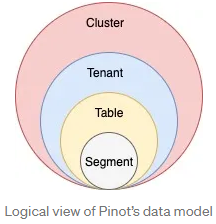
Segments — Raw data ingested by Pinot is broken into small data shards, and each shard is converted into a unit known as a segment. A segment is the centerpiece in Pinot’s architecture which controls data storage, replication, and scaling.
Tables and schemas — One or more segments form a table, which is the logical container for querying Pinot using SQL/PQL. A table has rows, columns, and a schema that defines the columns and their data types.
Tenants — A table is associated with a tenant. All tables belonging to a particular logical namespace are grouped under a single tenant name and isolated from other tenants.
If you are familiar with log-structured storage like Kafka, a segment resembles a physical partition while a table represents a topic. Both topics and tables expect to grow infinitely over time. Therefore, they are partitioned into smaller units so that they can be distributed across multiple nodes.
Mimarisel Bileşenleri Nelerdir?

Bileşenler
Açıklaması
şöyle. Yukarıdaki şekilde Broker, Server ve Controller görülebilir.
A typical Pinot cluster has multiple distributed system components: Controller, Broker, Server, and Minion. In production, they are deployed independently for scalability.
1. Pinot Broker
Açıklaması
şöyle. Sorguları işleyen bileşen
Brokers are the components that handle Pinot queries. They accept queries from clients and forward them to the right servers. They collect results from the servers and consolidate them into a single response to send it back to the client.
Broker sorgunun scatter-gather şeklinde çalışmasını sağlar. Açıklaması
şöyle.
Pinot executes queries in a scatter-gather manner instead of the databases that leverage the materialized views where query result has been precomputed.
Scatter-gather execution model Nedir?
Queries are received by brokers — which checks the request against the segment-to-server routing table — scattering the request between real-time and offline servers.
The two servers then process the request by filtering and aggregating the queried data, then returned to the broker. Finally, the broker consolidates each response into one and responds to the client.
2. Pinot Controller - Query Plane
Açıklaması
şöyle. Şekilde Ingestion Job nesnesi Controller'a bağlanıyor
You access a Pinot cluster through the Controller, which manages the cluster’s overall state and health. The Controller provides RESTful APIs to perform administrative tasks such as defining schemas and tables. Also, it comes with a UI to query data in Pinot.
3. Pinot Server - Data Plane
Servers host the data segments and serve queries off the data they host. There are two types of servers — offline and real-time.
Offline servers typically host immutable segments. They ingest data from sources like HDFS and S3. Real-time servers ingest from streaming data sources like Kafka and Kinesis.
3.1 Real-Time Servers
These ingest directly from Kafka, Kinesis, or Pulsar. They: • Subscribe to streams • Read events in memory • Make them queryable immediately • Build segments in the background
3.2 Offline Servers
These load pre-built segments from: • S3 • GCS • Azure Blob • HDFS
This is how historical data enters the system. The Broker hides this complexity. A query for the last 30 days might hit both real-time and offline servers and return a single result.
4. Pinot Minion
Minion is an optional component that can run background tasks such as “purge” for GDPR (General Data Protection Regulation).
Açıklaması şöyle
Minions are responsible for maintenance tasks. The controllers’ job scheduler assigns tasks to the minions. An example of a minions task is data purging. LinkedIn must purge specific data to comply with legal requirements. Because data is immutable, minions must download segments, remove the unwanted records, rewrite and reindex the segments, and finally upload them back into the system.
Upserts and Mutable data
Pinot supports upserts, which is rare in OLAP systems. Each table can define a primary key. As new events arrive: • Pinot checks the primary key index • Finds the latest version • Replaces older rows
This allows you to model: • Order updates • User state • Session data • Inventory changes
without duplicating records. This is critical for product-facing analytics.
Schema
Açıklaması
şöyle. Yani SQL ile sorgulanacak alanlar
When creating a real-time table, there are two things you need to prepare. First, you have to create a schema that describes the fields that you intend to query using SQL. Typically, these schemas are described as JSON, and you can create multiple tables that inherit the same underlying schema.
First, we need to create a Schema to define the columns and data types of the Pinot table. In a typical schema, we can categorize columns as follows.
Dimensions: Typically used in filters and group by clauses for slicing and dicing into data.
Metrics: Typically used in aggregations, represents the quantitative data.
Time: Optional column represents the timestamp associated with each row.
Örnek - steps-schema.json
{
  "schemaName": "steps",
  "dimensionFieldSpecs": [
    {
      "name": "userId",
      "dataType": "INT"
    },
    {
      "name": "userName",
      "dataType": "STRING"
    },
    {
      "name": "country",
      "dataType": "STRING"
    },
    {
      "name": "gender",
      "dataType": "STRING"
    }
  ],
  "metricFieldSpecs": [
    {
      "name": "steps",
      "dataType": "INT"
    }
  ],
  "dateTimeFieldSpecs": [{
    "name": "loggedAt",
    "dataType": "LONG",
    "format" : "1:MILLISECONDS:EPOCH",
    "granularity": "1:MILLISECONDS"
  }]
}
Table Definition
Açıklaması
şöyle.
Real-time veya
Batch Table olduğunu belirtir. Data source tanımı burada yapılır.
The second thing you need to create is your table definition. The table definition describes what kind of table you want to create, for instance, for real-time or batch. In this case, we’re creating a real-time table, which requires a data source definition so that Pinot can ingest events from Kafka.
Each table has a fixed schema and multiple columns, each of which can be a dimension or a metric. Pinot introduces a special timestamp dimension column called a time column. The time column is used when merging offline and online data
Ayrıca indekslemenin nasıl yapılacağı belirtilir. Açıklaması
şöyle.
The table definition is also where we describe how Pinot should index the data it ingests from Kafka. Indexing is an important topic in Pinot, as with mostly any database, but it is especially important when we talk about scaling real-time performance. For example, text indexing is an important part of querying Wikipedia changes. We may want to create a query using SQL that returns multiple different categories using a partial text match. Pinot supports text indexing that makes performance extremely fast for queries that need arbitrary text search.
Örnek -steps-table.json
{
  "tableName": "steps",
  "tableType": "REALTIME",
  "segmentsConfig": {
    "timeColumnName": "loggedAt",
    "timeType": "MILLISECONDS",
    "schemaName": "steps",
    "replicasPerPartition": "1"
  },
  "tenants": {},
  "tableIndexConfig": {
    "loadMode": "MMAP",
    "streamConfigs": {
      "streamType": "kafka",
      "stream.kafka.consumer.type": "lowlevel",
      "stream.kafka.topic.name": "steps",
      "stream.kafka.decoder.class.name": "org.apache.pinot.plugin.stream.kafka.KafkaJSONMessageDecoder",
      "stream.kafka.consumer.factory.class.name": "org.apache.pinot.plugin.stream.kafka20.KafkaConsumerFactory",
      "stream.kafka.broker.list": "localhost:9876",
      "realtime.segment.flush.threshold.time": "3600000",
      "realtime.segment.flush.threshold.size": "50000",
      "stream.kafka.consumer.prop.auto.offset.reset": "smallest"
    }
  },
  "metadata": {
    "customConfigs": {}
  }
}SELECT * FROM steps LIMIT 10;
SELECT userName, country, sum(steps) as total
FROM steps
WHERE loggedAt > ToEpochSeconds(now()- 86400000)
GROUP BY userName, country
ORDER BY total desc
SELECT userName, country, SUM(steps) AS total
FROM steps
GROUP BY userName, country
ORDER BY total desc
LIMIT 10
Segment Yapısı
Tables are partitioned into segments, subsets of a table’s records. A typical Pinot segment has a few dozen million records, and a table can have tens of thousands of segments.
Everything in Pinot is a segment. A segment is: • Columnar • Indexed • Immutable • Query optimized
Segments are built in two ways:
Real-time Path Events stream in from Kafka. Pinot buffers them in memory, makes them queryable instantly, and builds segments in the background. When full, segments are sealed and pushed to deep storage.
Batch Path A job reads Parquet or CSV from S3, BigQuery, or a lake, converts it into Pinot segments, and loads them into offline servers. Either way, queries hit segments, not raw files.
Servers are in charge of hosting segments and query execution. Pinot stores a segment as a directory in the UNIX filesystem, which consists of a metadata file and an index file:
- The segment metadata provides information about the segment’s columns: type, cardinality, encoding scheme, column statistics, and the indexes available for that column.
- The index file stores indexes for all the columns. The files are append-only.
Pinot stores multiple replicas of a segment for high availability. This also improves query throughput, as all the replicas participate in the query processing. Pinot’s servers have a pluggable architecture that supports loading columnar indexes from different storage formats. This allows servers to read data from distributed filesystems like HDFS or object storage like Amazon S3.
One of the primary advantages of using Pinot is its pluggable architecture. The plugins make it easy to add support for any third-party system which can be an execution framework, a filesystem, or input format.
In this tutorial, we will use three such plugins to easily ingest data and push it to our Pinot cluster. The plugins we will be using are
- pinot-batch-ingestion-spark
- pinot-s3
- pinot-parquet
pinot-admin komutu
AddTable seçeneği
Örnek
bin/pinot-admin.sh AddTable \ -schemaFile /tmp/fitness-leaderboard/steps-schema.json \ -tableConfigFile /tmp/fitness-leaderboard/steps-table.json \ -exec
{"status":"Table steps_REALTIME succesfully added"}
StartKafka seçeneği
Örnek
bin/pinot-admin.sh StartKafka -zkAddress=localhost:2123/kafka -port 9876